
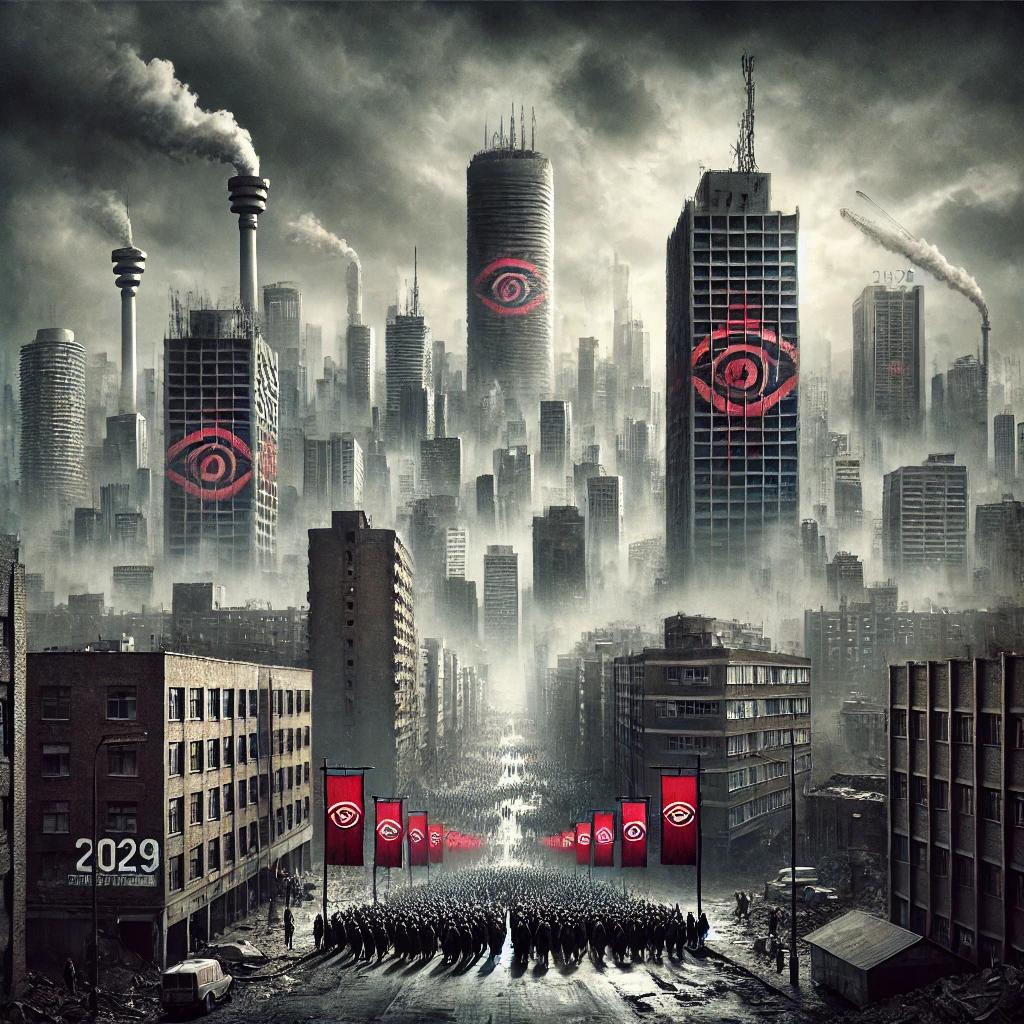
No one saw it coming. The polls didn’t see it coming. The analysts didn’t see it coming. The world didn’t see it coming.
It is night now, and the streets of Johannesburg are empty, there is not a person in sight. That is how it is nowadays in South Africa’s largest city. After 8 PM, no one is allowed outside, except the military. Anyone caught outside after 8 PM is immediately swept up and taken to a “temporary assessment facility” in Hillbrow. Not much is known about these “temporary assessment facilities”, except what they exist. The national news network, the South African People’s Broadcasting Corporation (SAPBC), has repeatedly denied that any harm has come to those who have been taken to these facilities. According to them, these facilities merely aim to help those individuals to adjust to life in the new South Africa. Social media and the internet are either banned or highly censored, so no one can share their experiences either. That being said, no one is known to have come back from a “temporary assessment facility” either.
Life in South Africa is very different now after the socialist revolution. The “Red Tide” as they called it swept through South Africa like a wildfire. It all started in Kwazulu-Natal, in the small town of Ulundi. In the lead up to the 2029 general election, things were not going well in KZN. There was constant protests and political instability like nowhere else in South Africa. The man of the people, Jacob Zuma passed away in the late summer of 2026. Zuma’s death brought the entire country to a standstill for almost a month. His body was embalmed and taken from Pretoria to his home in Nkandla. His body has been on display there ever since, and his entire homestead has been converted into a museum. After Jacob Zuma was put in his final resting place, was when the chaos in Kwazulu-Natal started, and unbeknownst to South Africans, when the socialist revolution started to shape.
Political turmoil
With the death of Zuma, came the death of the uMkhonto weSizwe (MK) party. Zuma was the leader of the MK party until the day of his death. Afterwards, the party descended into chaos, until it ultimately disbanded in 2027. Kwazulu-Natal was the MK party’s stronghold and it was the only province which the party governed. It initially lost the province to an ANC-DA-IFP coalition after the 2024 elections. Through clever political manoeuvring and recruitment of ANC and EFF heavy hitters, it managed to win every municipality in the 2026 local government elections. Even after their great success in KZN, members of the party were not entirely satisfied with the status quo. You see, the radical change that the party members wanted, just didn’t happened, and couldn’t happen for that matter. Their attempts to implement an “African law” system was constantly stifled by the constitutional court. Civil organisations such as OUTA and Afriforum were also a constant thorn in their side.
Constant in-fighting in the party ultimately led to it being disbanded. Other parties quickly swooped in to pick up the pieces, and claim KZN. Most of the cadres went back to the ANC, which was led by the then premier of Gauteng. He was the leader of the Radical Economic Transformation (RET) faction of the ANC, who took over power from Cyril Ramaphosa in a manner reminiscent of the Polokwane conference of 2009. It was seen as the best way forward for the ANC, who lost lots of support in the 2024 elections, and were humiliated in the 2026 local government elections. They lost all the major metros in South Africa, except for Mangaung (Bloemfontein). The ANC was on their knees, and they saw the disbanding of the MK party as a gift from the gods.
Not all of the cadres joined the ANC though. There were still some who thought that real change would never be realised through elections. They knew from history, that even landmark events such as the 1994 elections, never brought any real change. Yes, everyone had the right to vote now, and everyone had equal access to the economy etc., but everything that mattered was still in the hands of the minority, or western companies. The South African Communist Party (SACP) also monitored the events closely, as they were in an uneasy alliance with the ANC and COSATU since the 1994 elections. They left the tripartite alliance and contested the 2026 local government elections on their own. They got no support whatsoever, and they were the laughing stock of South African politics. The SACP top brass soon realised, that they would again have to ally with others to be politically relevant. For them, the disbanding of the MK party was also a gift from the gods, even though they didn’t realise it at the time.
One of those cadres who didn’t join the ANC, was the current president, supreme leader and commander in chief, comrade Ntokozo Mkhabela. He goes by name “Brilliance” outside of South Africa. That is the name the western media gave him for his shrewd political manoeuvring. The reality is, that “Brutal” would have been a more fitting name for our current president. Just as the world never really talked about the atrocities of Joseph Stalin after the second world war, the world also turned a blind eye to South Africa and their supreme leader. You see, comrade Ntokozo was not a run-of-the-mill South African politician, who got involved in politics for personal gain…
Comrade Ntokozo
Mkhabela grew up in a township outside of Ulundi in Kwazulu-Natal. He was born in 1996, as South Africa was still riding a wave of optimism after the 1994 elections. His mother was a domestic worker (something he grew up appalled by) and his father a long-distance truck driver. His father would often bring him back small mementos from trips to Zimbabwe or Namibia. Mkhabela had a comparatively stable childhood, except for his father being away for long stretches on the road. From an early age, he enjoyed reading, and would often spend lots of time in the Ulundi library. He excelled at school, and was head boy at Ulundi Primary. His excellent achievements got him a bursary to attend Michaelhouse in 2010.
His time at Michaelhouse fundamentally changed his perceptions and outlook towards life. He often felt like an outsider, given his background and his family’s social standing. He was one of few kids who came from a township, and although no one ever made him feel unwelcome, he didn’t quite fit in. It was here at Michaelhouse where Mkhabela felt the urge to start challenging the status quo. To him, institutions such as Michaelhouse was just a slap in the face of all poor people. The idea that a school can charge R300k per year in school fees (which was more than his parents made in 5 years working), was just obscene and institutions such as this elite boarding school should be abolished. He never stopped reading, and considered himself a lifelong learner. Michaelhouse had a very impressive school library, and Mkhabela spent most of his high school days there. He took a keen interest in philosophy, history, business and leadership. He graduated high school with 5 distinctions (Mathematics, English, History, Accounting and Economics), and got yet another bursary, this time to study accounting at the University of Cape Town. In high school, Mkhabela never got the chance to express himself politically. In university however, he had the freedom to do whatever he pleased.
Cape Town was always the most liberal part of South Africa, and Mkhabela enjoyed the freedom and diversity of the city and the university. UCT was also a hotbed of political and student activism, and he quickly got involved in #FeesMustFall and various other protests across the city and campus. He was arrested a couple of times, but no formal charges were ever laid against him. It was here at UCT, where Mkhabela got first hand exposure to politics, when he joined the Student Representative Council as part of the Economic Freedom Fighters (EFF). Mkhabela always spoke fondly about his early political years as part of the EFF.
It was during his second semester of his first year (he studied BCom Accounting), when he attended an EFF rally as part of the #FeesMustFall movement. He was still unsure what his exact political identity was up until this point. He saw Julius Malema giving a speech during the rally, but for him, it was more than just a speech. In Malema he saw someone with whom he could relate, and the message of the EFF struck a chord with him. Most of his adolescent years, he felt that South Africa was simply a country of the “haves and the have nots”. The problem was that the majority of the country (including his parents and his entire extended family) was part of the “have nots”. It was obscene that a handful of people could attend schools like Michaelhouse, when the rest of the country does not event have food or water, yet alone attend school. He knew deep down, that he was very fortunate to attend such a prestigious school, and he needed to use his education and opportunities to affect change for himself, his family and the country.
The message of the EFF was radical. At the time, no other party was as “in your face” as the EFF. They had a charismatic leader, and they were one of the few parties that actively tried to challenge the status quo. Other parties simply let unjust events, such as racial discrimination slide. The EFF on the other hand, had boots on the ground and protested and occasionally rioted to get their point across. For Mkhabela, this was a match made in heaven. Although he did not necessarily agree with everything the party did what their leader said, he saw political pressure being exerted by the party. In other words, he saw progress towards real meaningful change, which was all he ever wanted.
Join us over the coming weeks to follow the series
Join us in Part 2 of “2029: The Red Tide” for more background on Mkhabela, including his career, and how that further shaped his life. We will also talk about the events leading up to the 2029 elections and what happened thereafter. 2029 is a three part series, exploring the history of the Red Tide, the impact on the life of South Africans in Part 2, and Aftermath of the Red Tide in Part 3.